

Share to


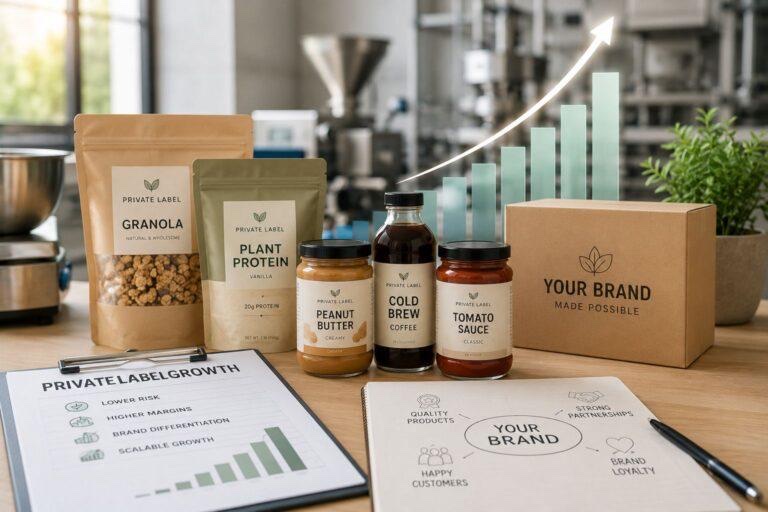
Private label has moved well beyond its traditional role as a lower-cost alternative to national brands. Today, retailers are investing heavily in their own product lines, focusing on quality, differentiation, and brand identity. For emerging food brands, this shift presents a unique opportunity, but one that is often misunderstood.
At first glance, private label and branded products may seem at odds. One builds retailer equity, while the other builds brand equity. In practice, the relationship can be more complementary, especially when approached strategically and in collaboration with the right manufacturing partners.
As brands evaluate how to scale, contract manufacturers are increasingly playing a role not just in production, but in helping navigate private label opportunities. Platforms like CoPack Connect are part of this evolution, making it easier to identify manufacturers that already operate within private label ecosystems and understand retailer expectations. That context matters when deciding how and where to participate.
Rethinking Private Label as a Growth Lever
There is still a perception among some emerging brands that private label work dilutes brand identity or distracts from core growth efforts. That concern is valid in certain cases, particularly when resources are limited. However, it overlooks the operational and financial advantages that private label can offer when managed correctly.
Private label programs can provide:
- Consistent production volume, which improves manufacturing efficiency
- Predictable revenue streams, reducing reliance on variable retail performance
- Faster market access, especially through established retail channels
For brands operating below optimal production scale, these factors can have a direct impact on cost structure. Higher, more stable volumes often translate into better pricing on ingredients, packaging, and production runs.
The key is to treat private label not as a replacement for brand-building, but as a parallel channel that supports it.
The Role of Contract Manufacturers in Private Label Expansion
Contract manufacturers sit at the center of most private label programs. They often have direct relationships with retailers, understand compliance requirements, and are familiar with the pace and expectations of private label development cycles.
For emerging brands, this creates an indirect entry point.
Instead of approaching retailers cold, brands can work with manufacturers who are already producing for those retailers. In some cases, this leads to:
- Opportunities to contribute formulations or concepts
- Joint development of retailer-specific products
- Increased visibility within retailer networks
Manufacturers also understand the nuances of private label production, including tighter cost targets, strict timelines, and detailed specifications. This operational knowledge can help brands avoid common pitfalls when entering this space.
Identifying manufacturers with this type of experience is not always straightforward. Structured sourcing tools like CoPack Connect help surface partners with relevant private label exposure, which can accelerate the learning curve.
Balancing Brand Identity and Private Label Participation
One of the more complex aspects of private label involvement is maintaining a clear brand position. Producing for a retailer under a different label can create internal tension, particularly if the products are similar.
This is where strategic boundaries become important.
Brands should consider:
- Product differentiation: Avoid offering identical formulations across branded and private label channels
- Channel segmentation: Separate retail channels where appropriate to minimize overlap
- Long-term positioning: Ensure private label work supports, rather than competes with, brand growth
In many cases, private label can serve as a testing ground. New formulations, ingredients, or formats can be developed and refined within a retailer program before being adapted for branded use.
This approach allows brands to experiment with less risk while still building operational experience.
Improving Operational Efficiency Through Volume
One of the most immediate benefits of private label participation is improved production efficiency. Manufacturing costs are heavily influenced by volume, and emerging brands often struggle with smaller, less predictable order sizes.
Private label programs can help smooth out production schedules by:
- Filling unused capacity in manufacturing runs
- Increasing order frequency
- Reducing downtime between production cycles
For co-manufacturers, this consistency is valuable. For brands, it often leads to better pricing and more reliable production slots.
This dynamic strengthens the relationship between brands and manufacturers. When both parties benefit from increased volume, collaboration tends to improve.
Accessing Retail Insights and Market Trends
Private label programs are closely tied to retailer strategy. This provides indirect access to valuable market insights that are not always available through traditional brand channels.
Through manufacturing partners, brands can gain visibility into:
- Emerging product trends within specific retailers
- Shifts in consumer preferences
- Pricing strategies and margin expectations
While confidentiality limits the level of detail shared, even high-level insights can inform product development and positioning.
Manufacturers that work across multiple retailer programs are often in a unique position to observe these patterns. Collaborating with them creates an additional layer of market intelligence that can influence broader brand strategy.
Managing Margin Expectations
Private label typically operates on tighter margins compared to branded products. Retailers expect competitive pricing, and manufacturers are often working within strict cost parameters.
For emerging brands, this requires a different mindset.
Success in private label depends on:
- Efficient formulation and ingredient sourcing
- Streamlined production processes
- Clear cost visibility at every stage
Working closely with a co-manufacturer is critical here. Manufacturers can provide guidance on how to adjust formulations or packaging to meet cost targets without compromising quality.
This is another area where partner selection matters. Manufacturers with private label experience are better equipped to balance cost and quality, which reduces the risk of entering unsustainable agreements.
Building Credibility and Scale
Participation in private label programs can also strengthen a brand’s credibility, even if the connection is not visible to consumers.
Operationally, it demonstrates:
- Ability to meet large-scale production requirements
- Experience working within strict retail standards
- Capability to deliver consistent quality at volume
These factors can support future negotiations with both retailers and investors.
At the same time, the increased scale can unlock new opportunities. Larger production volumes may justify investments in improved packaging, expanded product lines, or more efficient logistics.
Choosing the Right Entry Point
Not every private label opportunity is worth pursuing. The challenge for emerging brands is identifying opportunities that align with their capabilities and long-term goals.
This requires:
- Careful evaluation of production requirements
- Clear understanding of cost structures
- Alignment with manufacturing partners who can support both branded and private label work
Starting with the right manufacturing partner makes a measurable difference. Platforms like CoPack Connect help brands identify partners with relevant experience, including those already engaged in private label programs. This reduces the guesswork and allows brands to focus on opportunities that are more likely to succeed.
Expanding Without Losing Focus
Private label growth can be a valuable tool, but it requires discipline. Without clear boundaries, it can stretch resources and dilute strategic focus.
When approached thoughtfully, it can:
- Improve operational efficiency
- Provide stable revenue
- Open doors to new market opportunities
The key is integration. Private label should support the broader business, not compete with it.
A Practical Path to Growth
Private label is no longer just a retailer strategy. It has become part of how the broader manufacturing ecosystem operates. For emerging food brands, it offers a practical way to scale production, strengthen partnerships, and gain market exposure.
Contract manufacturers play a central role in making this work. Their relationships, operational expertise, and market insight create pathways that are difficult to access independently.
By working with the right partners and maintaining a clear strategic approach, brands can use private label as a complement to their growth, not a compromise.
And as sourcing becomes more structured and data-driven, tools like CoPack Connect are helping brands find those partners more efficiently, setting the stage for more informed and effective expansion.
Share to
Related Resources

Climbing Everest Without a Sherpa: The Risks of NOT Using an External Manufacturer
Ask anyone who has stood at Everest Base Camp and they’ll tell you the same thing: no matter how strong…
May 29, 2026
From Production to Shelf: How Contract Manufacturers Support Retail Expansion
Retail expansion is the ambition. Surviving it is the discipline. For emerging brands, breaking into a major grocery chain or…
May 20, 2026

Driving Innovation through Co-Manufacturer R&D Labs
Innovation has always been a defining factor in the success of emerging brands. Whether it is a new flavor profile,…
May 14, 2026
